
Cab branding and car wraps in India: a planner's guide
How cab branding works in India: the wrap formats on offer, how many cars a city needs, how long to run, what drives cost, and how to check that every branded car is really on the road.
· 6 min read · TaxiTop Media
A hoarding waits for people to drive past it. A branded cab goes to them. It spends the whole day moving through offices, markets, stations and housing colonies, and it comes back to the same neighbourhoods again and again. That is why cab branding has been part of TaxiTop Media from the start: the company grew out of media in Mumbai’s cabs, and car wraps are still one of the things we do most.
This guide covers how cab branding works in India, the formats, how to size a fleet, and the questions to ask before you sign off a quote.
Why brands put their message on cabs
- Reach that moves. One car covers many parts of a city in a day, so a fleet spreads the brand across areas that would need dozens of fixed sites.
- Repetition. Cabs work the same zones day after day. People see the brand on the way to work, at the market and outside the station, and it sticks.
- Eye level, street level. A wrapped car is seen up close, at traffic lights and in slow traffic, not just from a distance.
- Scale up or down. A local launch can start with a few dozen cars in one city. A national brand can run hundreds of cars across several cities at the same time.
The main formats
| Format | What it is | Best used for |
|---|---|---|
| Full wrap | Vinyl covering most of the car’s body | Maximum impact for launches and big festive pushes |
| Partial wrap | Doors, side panels or the boot only | Wider fleets on a tighter budget |
| Rear and side panels | Smaller printed panels on fixed spots | Frequency at scale, especially in tier-2 cities |
| In-cab branding | Danglers, seat-back cards and stickers inside the cab | A captive passenger with time to read |
| Toto and auto branding | E-rickshaw (toto) panels and auto-rickshaw hood branding | Last-mile reach in smaller towns and dense neighbourhoods |
Most strong campaigns combine an exterior format, which reaches the street, with an interior one, which reaches the person sitting inside.
How many cars, and for how long?
There is no single right number. The fleet size depends on the size of the city, how many neighbourhoods you need to cover and how often you want people to see the brand. As a rule of thumb, it is better to cover a few cities properly than to spread a thin fleet across many.
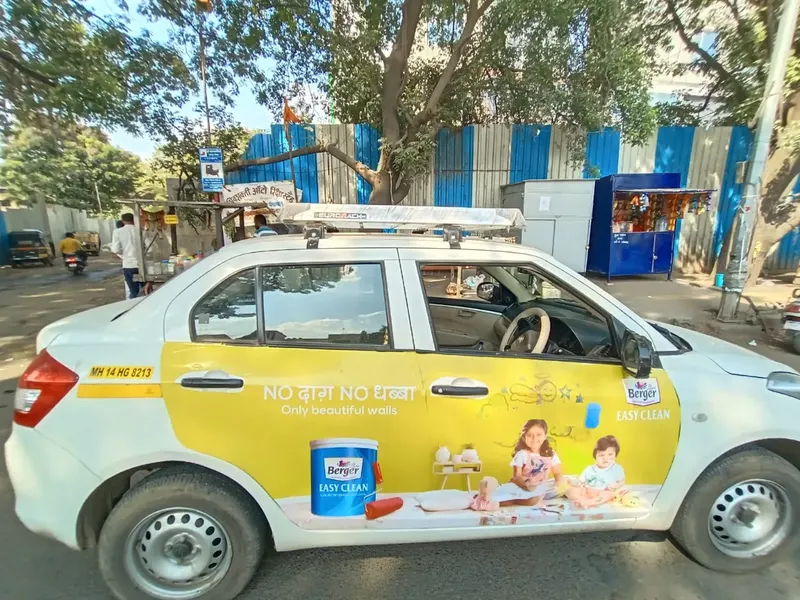
For scale, our cab branding campaign for Berger Paints put more than 1,400 branded cabs on the road across nine cities for three months. At the other end, a focused single-city campaign can work with around a hundred cars: we wrapped 112 Kolkata cabs for Hoichoi in October and November 2018. You can read both on our case studies page.
On duration, the campaigns we run usually last one to three months. That gives each car time to cover its routes many times over. Shorter bursts work around a launch date or a festival, when the brand needs to be everywhere for a few weeks.
Plan routes around the audience
Before choosing cars, decide who you want to reach and where they spend their day. A food delivery or quick-commerce brand may want residential areas in the evening. A B2B or banking brand may want business districts during office hours. A paint or consumer-durables brand may want the markets and dealer clusters where people actually shop.
Then match the fleet to those zones. Ask your partner how cars are assigned, which areas they mostly cover, and whether the plan changes by city.
What drives the cost
We do not publish rate cards in articles, because rates change with the city, the season and the size of the fleet. These are the factors that move the price:
- Number of cars and cities. Larger fleets usually bring a lower cost per car.
- Format. A full wrap costs more to print and install than rear or side panels.
- Duration. Most cab branding is priced by the month per car.
- Production and installation. Vinyl quality, printing and fitting are often quoted separately. Good vinyl lasts the campaign and comes off without damaging the paint.
- Driver payments and monitoring. The fleet owner or driver is paid to keep the branding on for the agreed period, and someone has to check that it stays on.
When you compare quotes, check what each one includes: media, printing, installation, monitoring, removal and photo proof. Two quotes for “the same” campaign can differ because one leaves something out.
Proof: how to know the cars are really out there
This is the part that separates a good cab campaign from a weak one. Ask for:
- Dated photos of every car, from the left, right and rear, at the start of the campaign.
- Regular check-ins through the campaign, not just on day one, so torn or removed branding gets fixed.
- A car-wise list showing the city and the date each vehicle was branded.
- Removal photos at the end, if the vinyl has to come off.
We share dated left, right and rear photos for each branded vehicle as standard, so a client can check any car in the fleet.
Getting the creative right
A wrapped car is often seen for a few seconds, from the side, while it is moving. Keep it simple:
- One message, one visual. The brand name and a single idea should read in about two seconds.
- Big logo, high contrast. Bright colours and bold type survive dust, rain and night-time street lighting.
- Mind the doors and windows. Handles, panel gaps and glass break up a design. Put key text on flat panels.
- Keep the call to action short. An app name or a simple web address works better than a long phone number.
Planning a cab branding campaign?
Tell us your cities, dates and audience, and we will suggest a fleet size, formats and a plan. You can also look at our car wraps and cab branding service page, or try the campaign planner on our home page.