
Festive-season outdoor advertising in India: planning for Diwali, Chhath and the wedding season
How to plan hoardings, cab and car branding, metro branding, DOOH and BTL activations for Diwali, Chhath and the winter wedding season in India, with a practical timeline and checklist.
· 8 min read · TaxiTop Media
For most Indian categories, the festive season is the busiest selling stretch of the year. In 2026, Diwali (Lakshmi Puja) falls on Sunday, 8 November, and Chhath Puja follows a week later, with Nahay Khay on 13 November and the evening and morning arghya on 15 and 16 November (Drik Panchang). Close behind comes the winter wedding season, which in much of north and east India runs roughly from November to February, around auspicious dates that vary by region and community.
That gives brands three overlapping moments: the run-up to Diwali, a regional peak around Chhath, and a long wedding tail. Outdoor media works well across all three, because people are out on the streets, in markets and malls, and on the metro more than usual. It also gets crowded. This guide covers how to plan for it.
Why festive outdoor is different
Three things change in the festive weeks.
- People are out of home. Shopping trips, pandal and ghat visits, family travel and weddings all happen outside the house. Outdoor and transit media sit along those journeys.
- Inventory gets tight. The best hoarding sites, metro stations and festival venues are booked early, and prime puja and festival spots are often gone well before the festival.
- Clutter goes up. Every brand wants the same streets in the same weeks. A good site with a weak or generic creative gets lost.
The practical answer is to plan earlier than feels necessary, pick fewer but better-placed sites, and give each format a clear job.
Give every format a job
| Format | Job in a festive plan | Works best for |
|---|---|---|
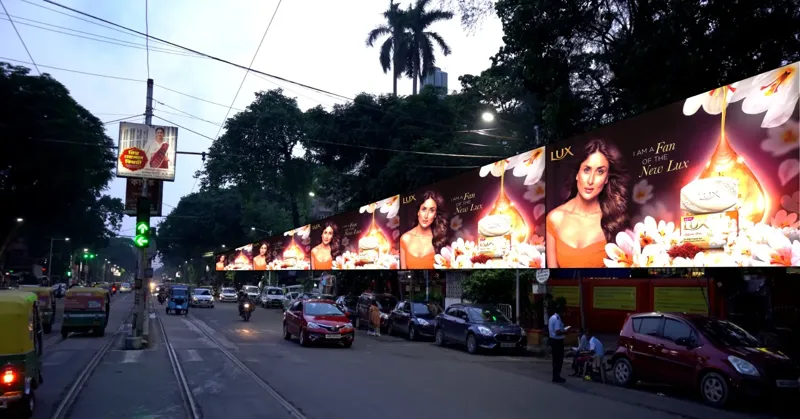
| Hoardings and billboards | Announce the offer to a whole market road, junction or highway corridor | Market areas, shopping streets, routes into a town |
| Cab and car branding | Carry the brand across the city, all day, including into neighbourhoods without fixed sites | City-wide reach, launches, multi-locality offers |
| Metro branding | Repeat the message to the same commuters every day in the weeks before the festival | Office-goers, students, shoppers heading to malls and markets |
| DOOH and RetailVision | Change creative by day or by offer, and reach shoppers close to the shelf | Countdown messaging, day-wise offers, retail and FMCG |
| BTL activations | Put the product in people’s hands at venues, malls, societies and festival grounds | Sampling, demos, trials, lead capture |
A typical festive mix uses one lead format for impact (a hoarding cluster, a station takeover or a festival-venue LED wall), one frequency format that repeats the message (cab branding, in-train panels, DOOH loops) and, where the product benefits from trial, an activation layer on the ground.
Diwali: build up, then countdown
Diwali buying starts well before the day itself, with Dhanteras and the days around it especially important for jewellery, consumer durables, home and gifting. Plan the campaign as two phases:
- Build-up. Static and transit formats (hoardings, cab wraps, metro panels) go live early and carry the brand and the main offer.
- Countdown. In the last week or two, use formats where the creative can change quickly. DOOH screens can switch from “offer starts” to “last days” to “Happy Diwali” without reprinting. That is where digital out-of-home earns its place.
Festival-led metro campaigns can be short and sharp. For Akshaya Tritiya, another important day for jewellery buying, we ran Jewelbox on 18 platform-door panels across five Delhi Metro stations from 18 April to 3 May 2025, timed around the festival rather than booked for a full quarter. The same thinking works for Diwali: book the window that matters, in front of the commuters who will be shopping.
Chhath: a regional peak
Chhath Puja is observed most widely by communities from Bihar, Jharkhand and eastern Uttar Pradesh, and in cities with large communities from those regions, including Delhi NCR, Kolkata and Mumbai. Much of it happens at ghats, riverbanks and ponds, at sunset and sunrise.
For brands, that means:
- Location matters more than scale. Sites on the roads to ghats and in the localities where the festival is celebrated matter more than a city-wide buy.
- Tone matters. Chhath is a devotional festival. Creative that respects the occasion works better than a hard sell.
- Travel is part of it. Many people travel home for Chhath, so stations, bus routes and roads into eastern cities and towns carry festive travellers in the days before.
If you are already running a Diwali campaign, Chhath can often be added as a short regional extension rather than a separate plan.
The wedding season: a long tail
The wedding season is less a single peak and more a series of dates. Jewellery, apparel, banquet venues, caterers, decorators, travel and home brands all benefit, and the buying window around each wedding can run for weeks.
That suits formats that can stay up longer and work locally: hoardings near wedding-shopping markets, cab branding across the localities where people shop, and DOOH or in-store screens that can rotate offers through the season. Plan it as an always-on layer that runs after Diwali, rather than squeezing it into the festive burst.
Learning from Durga Puja
Kolkata’s Durga Puja shows what festival media can do when it is planned well. For Puja 2024, we put Patanjali on a 10,000 sq ft LED wall at Tridhara, one of South Kolkata’s busiest pujas, from 25 September to 15 October. It was the first large-scale LED wall at a Durga Puja in Kolkata. Patanjali held a 10-second slot in a two-minute loop, about 525 plays a day, plus digital LED entrance gates through the peak days.
Three lessons carry over to Diwali, Chhath and weddings: book the venue or site early, use digital where the crowd is biggest so the creative can change through the days, and match the media dates to the days people are actually out.
A practical planning timeline
These are working rules of thumb, not fixed lead times. Availability, approvals and production vary by city, format and operator, so check them for your plan.
| When | What to do |
|---|---|
| 8 to 10 weeks before | Fix the cities, audiences and objective. Shortlist formats. Ask for availability on prime sites, stations and venues. |
| 6 to 8 weeks before | Confirm sites and dates. Brief creative for each format, not one design stretched across all. |
| 4 to 6 weeks before | Submit creative for operator approvals where needed (metro and some venues require this). Lock activation venues and permissions. |
| 2 to 4 weeks before | Print and produce. Plan installation windows. Load DOOH creative and day-wise versions. |
| Festive window | Go live. Check proof of display. Switch DOOH creative as the festival approaches. |
| After the festival | Collect dated photos and play logs, compare against store or enquiry data, and decide what to keep running into the wedding season. |
Starting late? If the festival is only a few weeks away, focus on formats that are usually quicker to get live, such as DOOH screens, cab branding on available fleets and on-ground activations, and keep the plan tight. It is better to own a few routes or stores well than to spread thin.
Festive campaign checklist
- Objective is clear: awareness, footfall, trial or sales for a specific offer.
- Cities and localities chosen by where your buyers shop, travel and celebrate.
- One lead format, one frequency format, and an activation layer if trial matters.
- Prime sites, stations and venues requested early.
- Creative written for each format: a few words for road sites, more for metro panels, day-wise versions for DOOH.
- Festival tone respected, especially for devotional occasions like Chhath.
- Approvals, permissions and installation windows built into the schedule.
- Proof of display agreed upfront: dated photos for static and transit, play logs for digital.
- A plan for the wedding season after the festive burst.
Plan your festive campaign
TaxiTop Media plans and runs outdoor, transit, DOOH and activation campaigns across India, from Kolkata to Delhi, Mumbai and tier-2 towns, with dated proof of display. Try our campaign planner for a quick suggested mix, or share your cities, dates and audience at sales@taxitopmedia.in or on WhatsApp.
Sources
- Drik Panchang, Lakshmi Puja (Diwali) 2026 timings, New Delhi: drikpanchang.com
- Drik Panchang, 2026 Chhath calendar, New Delhi: drikpanchang.com
- TaxiTop Media case studies (Patanjali at Tridhara, Jewelbox on Delhi Metro): taxitopmedia.in/work