
In-store digital screens in India: a brand's guide to retail media
How in-store digital screens and retail media work in India: where screens sit, who they suit, how to design for a shopper, how to plan a campaign and what proof to ask for.
· 6 min read · TaxiTop Media
Most outdoor advertising speaks to people on the move. In-store screens speak to someone who is already shopping, a few steps from the shelf, with a basket or trolley in hand. That is why retail media has become one of the most talked-about parts of Indian advertising. This guide explains what in-store digital screens are, which brands they suit, how to design and plan a campaign, and what proof to ask for.
What are in-store digital screens?
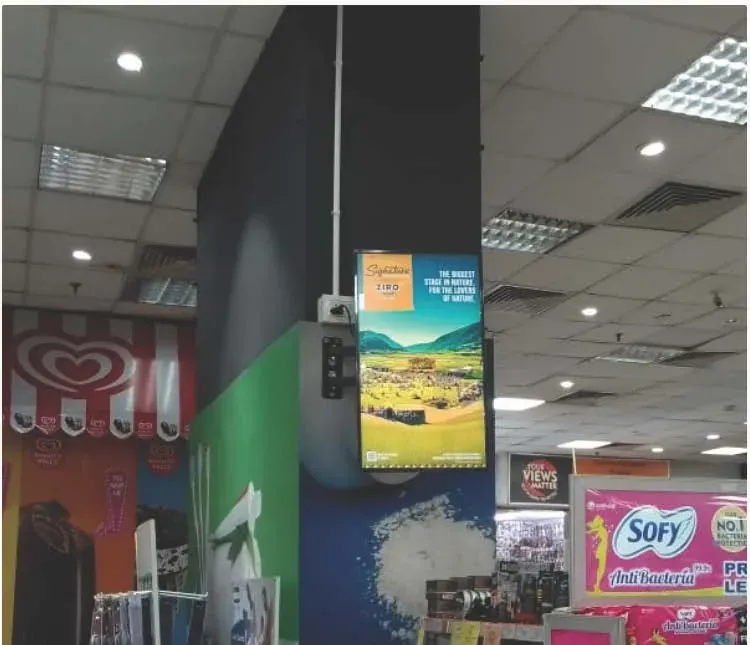
In-store digital screens are display screens placed inside a retail store, such as a supermarket or department store, that play adverts in a loop. They are a form of digital out-of-home advertising, or DOOH (see our DOOH guide), and are often grouped under the wider term “retail media”.
Retail media in India is mostly talked about in terms of online marketplaces. PMAR 2026 puts ecommerce and retail media advertising at ₹10,257 crore in 2025, up 27% (PMAR 2026 via Roastbrief). That figure is mainly online. In-store screens are the physical counterpart: the same idea of reaching a buyer close to the moment of purchase, but inside the shop.
Where the screens sit
The value of a screen depends on where it is placed. Common positions include:
- Entrances and billing areas. Shoppers are standing still here, so there is time to take in a message.
- Aisles and category zones. A screen near the staples, snacks or personal-care shelves can speak to that category directly.
- Near the shelf. The closest thing to a point-of-purchase message, a few metres from the product itself.

Which brands it suits
In-store screens work best for brands whose product is on the shelf in that very store, or sold in the same category:
- Packaged food, beverages and personal care. The shopper can pick the product up right after seeing the advert.
- New launches. A launch needs awareness and trial together, and a screen near the shelf supports both.
- Offers and promotions. Digital creative can change quickly, so a festival offer or a limited-time price can go on screen and come off without reprinting.
- Brands that sell outside the store too. A bank, a mobile service or a local service brand can still reach a large number of households that shop there.
If your product is not sold in or near the store, an in-store screen is usually a weaker fit than a road or metro site, and it is better to start with the audience, not the format.
Designing for a shopper
A shopper looks at a screen for a few seconds while doing something else. A few rules help:
- One message. A single offer or a single product beats a list.
- Big pack shot and logo. The shopper should recognise the product on the shelf after seeing it on the screen.
- Short, clear text. Keep it to a few words, large enough to read from a distance.
- Check the orientation. Many in-store screens are vertical, so a horizontal TV advert will not fill the frame. Ask for the exact screen size, orientation and file specifications before you design.
- Plan for sound-off. Assume the advert will be watched without sound.
How to plan a campaign
Start with the stores and the audience, then decide the schedule:
- Choose the stores. Pick stores in the neighbourhoods where your buyers live and shop, not just the biggest ones.
- Choose the dayparts. Weekday evenings and weekends are usually busier. Match your offer to the time the shopper is most likely to buy.
- Set the duration. A single burst around a launch or festival is common. Longer bookings help build recall.
- Keep creative fresh. Because the screens are digital, you can rotate two or three versions of the creative during the campaign.
- Pair it with other media. A hoarding or cab branding gets people thinking about your brand outside; the in-store screen reminds them when they are choosing. See our guides to hoardings and cab branding.
What proof to ask for
Ask the network owner for a store list and a screen count before you book, the exact specifications for the creative, a play log or photo report during the campaign, and photos of your advert on screen in the stores. Be clear about how many times a day your advert will play and in which stores.
An example: RetailVision in Kolkata
RetailVision is our own in-store screen network: about 100 screens across 15+ Spencer’s Retail stores in Kolkata. Brands can choose stores and dayparts, and change creative without reprinting. We do not publish a rate card, because cost depends on stores, duration and the number of plays. See the RetailVision page for the network and its photos.
A quick checklist
- Confirm your product is sold in the stores you are considering.
- Ask for the store list, screen count, screen size and orientation.
- Design one message with a big pack shot and logo, for sound-off viewing.
- Pick stores and dayparts to match your buyers.
- Plan two or three creative versions for a longer campaign.
- Agree the proof, such as play logs and on-screen photos, before you start.
Plan in-store screens with TaxiTop Media
TaxiTop Media is a Kolkata-based outdoor, transit and DOOH company. Alongside RetailVision, we run hoardings, cab branding, metro media and on-ground activations in cities across India. See RetailVision or email sales@taxitopmedia.in with your brief.